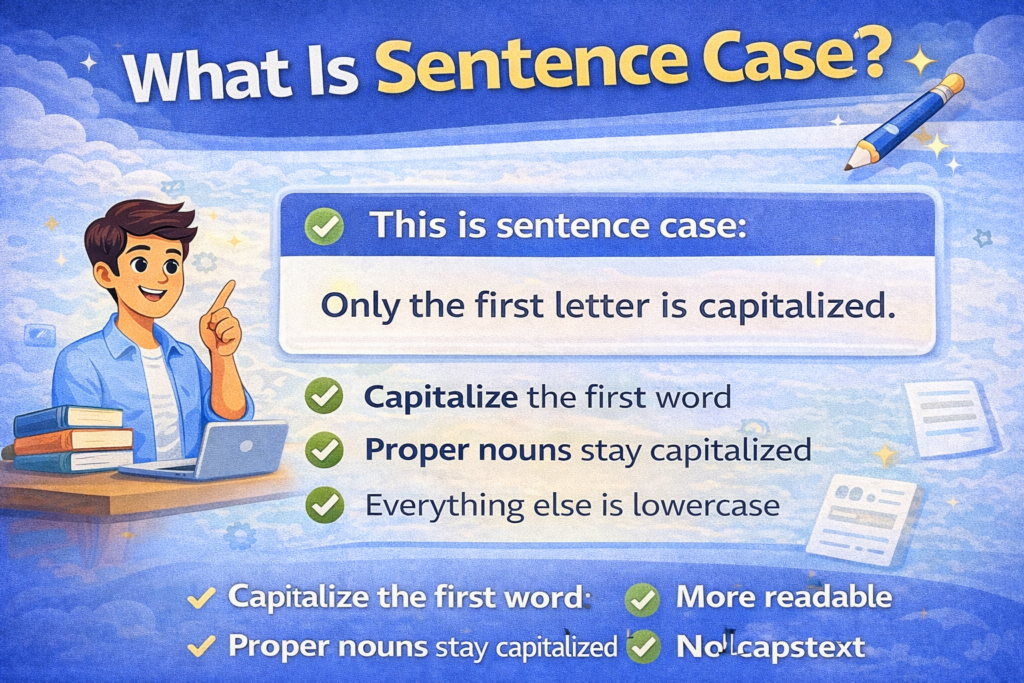
If you read this sentence carefully, you’ll notice something simple: only the first word starts with a capital letter.
That’s exactly what sentence case is
sentence case converter is the most natural way we write in English. It’s the format you use in emails, blog posts, messages, and everyday communication without even thinking about it.
Let’s understand it clearly and practically.
Sentence Case in One Line
Sentence case means:
Capitalize the first word of a sentence, and keep the rest of the words lowercase except proper nouns.
That’s it. No complex rules. No styling tricks.
A Quick Example
Here’s plain lowercase text:
Only the first word (“How”) is capitalized.
Now compare that with title case:
Why Sentence Case Feels Easier to Read
Our brain reads words by recognizing their shape. When every important word starts with a capital letter, the reading rhythm slightly changes.
Sentence case keeps the flow smooth because:
- It follows normal grammar rules
- It avoids unnecessary capital letters
- It looks less aggressive than ALL CAPS
- It feels conversational
That’s why most blog content and articles use sentence case for body text.
Where Is Sentence Case Commonly Used?
You’ll see sentence case in:
- Blog paragraphs
- Article descriptions
- Email writing
- Product descriptions
- Instructions and tutorials
- Social media captions
Basically, anywhere long-form readability matters.
The Core Rules (Made Simple)
Let’s simplify the rules without overcomplicating them.
1. Capitalize the First Word
Always start the sentence with a capital letter.
Example:
2. Capitalize Proper Nouns
Names of people, places, brands, and specific titles stay capitalized.
Example:
3. Everything Else Stays Lowercase
Unless grammar requires capitalization, keep words lowercase.
Example:
Simple and clean.
Sentence Case vs All Caps
Let’s compare visually:
ALL CAPS:
Sentence case:
The second version feels calmer and more readable.
All caps may grab attention, but sentence case keeps users comfortable.
Sentence Case vs Title Case
Here’s a quick real comparison:
Sentence case:
Title case:
Sentence case is softer.
Title case is more structured and formal.
Both are useful but for different purposes.
Does Sentence Case Help With SEO?
Directly? No. Search engines don’t rank content based on capitalization style.
But indirectly, sentence case helps because:
- It improves user experience
- It reduces visual fatigue
- It keeps paragraphs clean and readable
- It supports better engagement
Good formatting doesn’t guarantee rankings but poor formatting can hurt readability.
Common Mistakes to Avoid
Here are things that make content look unprofessional:
- randomly capitalizing words in a sentence
- Writing full paragraphs in ALL CAPS
- Mixing title case and sentence case inconsistently
- Forgetting to capitalize proper nouns
Consistency builds trust.
When Should You Choose Sentence Case?
Use sentence case when:
- Writing blog content
- Publishing guides or tutorials
- Drafting emails
- Creating descriptions
- Writing anything longer than a heading
If the content is meant to be read comfortably, sentence case is usually the safest option.
How to Convert Text to Sentence Case Instantly
If you’re dealing with messy formatting maybe text copied from PDFs or written in all caps — you don’t have to fix it manually.
An online case converter tool can:
- Apply sentence case instantly
- Fix large text blocks
- Save editing time
- Maintain consistent formatting
It’s especially useful when working with long articles.
Final Thoughts
Sentence case is the most natural and reader-friendly capitalization style in English writing. It keeps your content clear, professional, and easy to understand. While it may seem like a small formatting detail, proper capitalization improves the overall presentation of your content. In most situations especially for long-form writing sentence case is the smart and safe choice.
FAQs
Q: What is sentence case in writing?
A: Sentence case is a capitalization style where only the first word of a sentence is capitalized, along with proper nouns.
Q: How is sentence case different from title case?
A: In sentence case, only the first word is capitalized. In title case, most important words start with capital letters.
Q: When should I use sentence case?
A: Sentence case is best for paragraphs, blog content, emails, product descriptions, and long-form writing.
Q: Should proper nouns be capitalized in sentence case?
A: Yes, names of people, places, brands, and specific terms remain capitalized.
Q: Is sentence case better for readability?
A: Yes, sentence case is generally easier to read in longer text compared to all caps or over-capitalized formats.
Q: Does Google prefer sentence case?
A: Google does not prefer a specific case format, but clear and consistent formatting improves user experience.
Q: Can I convert text to sentence case automatically?
A: Yes, you can use an online case converter tool to instantly apply sentence case formatting.
Q: Is sentence case used in headlines?
A: It can be used, but title case is more common for blog titles and headlines.
Q: Why does sentence case look more natural?
A: Because it follows normal grammar rules used in everyday writing.
Q: Can I use sentence case for SEO content?
A: Yes, sentence case works well for SEO content as it improves readability and user engagement.
Read Also
- Best Ways to Clean Messy Text Online (Complete Guide for Fast Text Formatting)
- How to Remove Special Characters from Text Easily
- Social Media Character Limits Explained (Complete Guide)
- Character Counter vs Word Counter: What’s the Difference?
- Why Word Count Matters in Content Writing
- Word Count Tips for Bloggers and Students
- Best Free Word Counter Tools for Writers
- How to Count Words in an Essay Online
- What Is a Word Counter Tool and Why You Need It
- Difference Between Uppercase and Lowercase Text