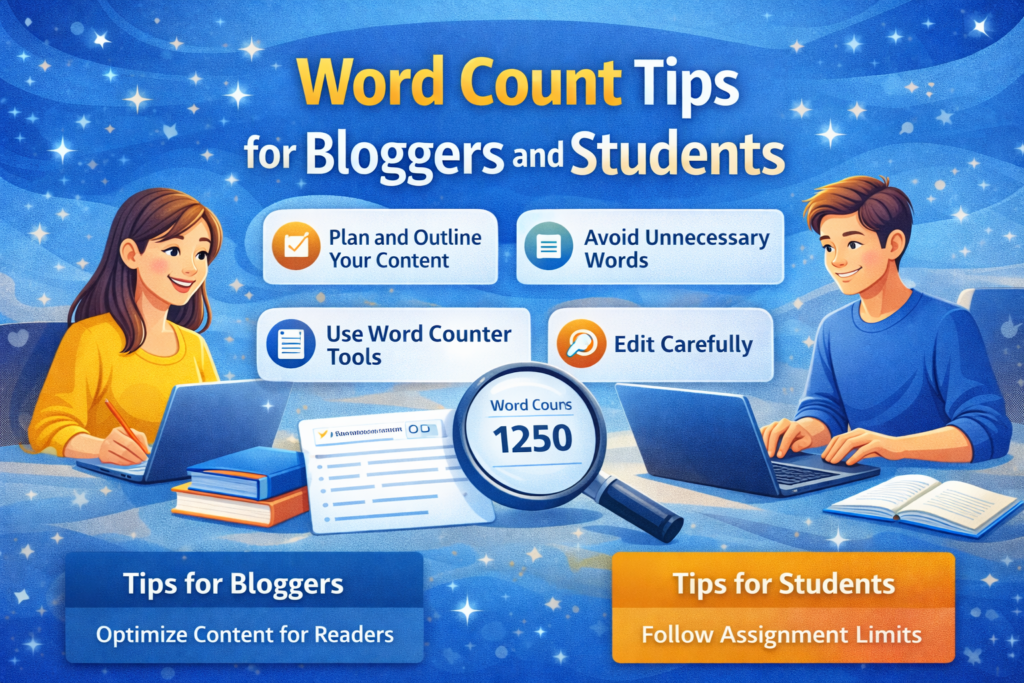
Word count plays an important role in both academic and online writing. Whether you are writing a blog post or preparing an essay for school, maintaining the right word count helps ensure your content is clear, organized, and complete. Many writers struggle to stay within the required word limit or to reach the minimum word count needed for a topic.
For bloggers, word count can influence search engine visibility and readability. For students, it often determines whether an assignment meets academic guidelines. Understanding how to manage word count effectively can improve both writing quality and productivity.
In this guide, we will explore useful word count tips for bloggers and students so you can create well-structured content while meeting the required length.
Why Word Count Matters in Writing
Word count helps writers organize their thoughts and maintain balance in their content. A piece of writing that is too short may not provide enough information, while overly long content may include unnecessary details that distract readers.
For bloggers, word count is often related to search engine optimization (SEO). Longer, well-structured articles usually provide more detailed information and may perform better in search results. However, quality is always more important than simply increasing the number of words.
Students also need to pay attention to word limits because many assignments require a specific number of words. Staying within this range shows that the student understands the topic and can explain ideas clearly without adding irrelevant content.
Tips to Manage Word Count Effectively
1. Start with a Clear Outline
Before writing, create a simple outline that includes an introduction, main points, and conclusion. This helps you organize ideas and ensures that each section contributes to the overall word count.
2. Focus on Key Points
Instead of adding unnecessary sentences, focus on explaining the most important ideas clearly. This improves the quality of the content and helps you stay within the word limit.
3. Avoid Repetition
Repeating the same information in different ways can increase word count without adding value. Try to keep sentences concise and meaningful.
4. Edit and Refine Your Content
After finishing the first draft, review the content and remove unnecessary words. Editing helps improve readability and ensures that every sentence contributes to the main topic.
5. Use a Word Counter Tool
One of the easiest ways to manage word count is by using an online word counter tool. These tools instantly show the total number of words, characters, sentences, and paragraphs in your content.
Word Count Tips Specifically for Bloggers
Bloggers often need to maintain a balance between informative content and reader engagement. Articles that are too short may not answer the reader’s question completely.
A good strategy is to focus on covering the topic in detail while keeping paragraphs easy to read. Using headings, bullet points, and short sections makes blog posts more structured and reader-friendly.
Bloggers should also monitor the word count while writing to ensure the article stays within the ideal range for the topic.
Word Count Tips for Students
Students frequently receive assignments with strict word limits. Managing word count effectively can help them present ideas clearly while meeting academic requirements.
One helpful approach is to divide the word limit among different sections of the essay. For example, a typical essay may include an introduction, several body paragraphs, and a conclusion.
Students should also review their work carefully to remove unnecessary words and ensure that each sentence contributes to the argument or explanation.
Tools That Help Manage Word Count
Online word counter tools make it easy to track the length of your content while writing. These tools provide instant statistics such as:
- Total word count
- Character count
- Sentence count
- Paragraph count
- Estimated reading time
Using these tools allows bloggers and students to quickly check whether their content meets the required length.
FAQs
Q: Why is word count important for bloggers?
A: Word count helps bloggers ensure that their articles provide enough information for readers. Longer and well-structured posts often perform better in search engines when they cover topics thoroughly.
Q: What is the ideal word count for a blog post?
A: The ideal word count depends on the topic, but many blog posts perform well when they contain detailed information and clear structure rather than focusing only on length.
Q: Why do teachers set word limits for assignments?
A: Teachers use word limits to encourage students to present ideas clearly and concisely while covering the topic properly.
Q: How can I increase the word count of my writing?
A: You can increase word count by adding explanations, examples, or additional details that help clarify your ideas without repeating information.
Q: How can I reduce word count in an essay?
A: To reduce word count, remove unnecessary words, avoid repetition, and combine sentences where possible.
Q: What is the easiest way to track word count?
A: The easiest way is to use an online word counter tool, which automatically calculates the number of words and other text statistics.
Read Also
- Best Ways to Clean Messy Text Online (Complete Guide for Fast Text Formatting)
- How to Remove Special Characters from Text Easily
- Social Media Character Limits Explained (Complete Guide)
- Character Counter vs Word Counter: What’s the Difference?
- Why Word Count Matters in Content Writing
- Word Count Tips for Bloggers and Students
- Best Free Word Counter Tools for Writers
- How to Count Words in an Essay Online
- What Is a Word Counter Tool and Why You Need It
- Difference Between Uppercase and Lowercase Text